

Simple Exercise-Big Results
Kettlebells, provide the necessary means to engage a large muscle mass in minimal time. They initiate the muscles of the Anterior & Posterior Chain and create the stimulus which maintains an elevated metabolic rate post-exercise; which helps burn calories for a significant period after you’ve stopped exercising. Whereas, going for a long slow jog, although better than doing diddly-squat, can have a jarring impact on the joints if you’re overweight and your metabolic rate returns to pre-exercise values almost immediately. So it’s not that brilliant for fat loss even if you jog for long periods of time.
Rhythmic & Non ‘Jarring’ Exercise
The Kettlebell swing allows the performer to impart a significant amount of force to the Kettle Bell. Without getting too ‘sciencey’ FORCE = MASS X ACCELERATION (Newton’s Second Law). The MASS in this video is the 16 kg Kettle Bell and the harder you accelerate it (swing it) the greater Force you produce and the more muscle mass is required to create the FORCE. This type of rhythmic, non jarring, exercise allows a high-intensity workout that spares the joints.
Power
Power = Force X Velocity. Velocity being the distance covered in a certain time in a specific direction (Vector). Conventionally, Olympic Lifts like Clean & Jerk and Snatch are used to develop the necessary Power for a variety of sports. However, the skill element required to execute those lifts render those lifts potentially unsuitable for certain performers, because age & physique might increase their risk of injury. For example, someone with a rounded upper-back (Kyphosis) might injure themselves if they tried to perform Olympic Lifts. Although they might be OK to perform a basic Power Clean.

Kettlebells
Kettle Bell swings offer a safer alternative to Olympic type lifting, especially when you’re operating outdoors because you can let the Kettle Bell go if it goes wrong, providing you choose a safe, preferably grassy, area! In fact the Kettle Bell would travel a longer distance, because of the length of the arc of the swing, allowing you to impart power throughout the movement.
Bonus Effects
Lean Muscle Mass
In the severely de-conditioned dude Kettle Bell Swinging quickly builds muscle and connective tissue strength; which is awesome for injury prevention. More muscle mass on the body means that more calories are required just to maintain that extra muscle. Therefore, you lose fat and generally look leaner and more muscular. This doesn’t mean you can go out and consume a Wildebeest with fries after every workout. But it might tip the balance to positive weight loss ‘if’ you’re following a sensible diet.
Forearm Strength
The Single Arm Kettle Bell supercharges your wrist and forearm strength and endurance. Build up to a 100 Kettle Bell Swings swapping hands every 20 swings, with the maximum weight you can handle with excellent form, and tell me your forearms aren’t screaming. This type of conditioning is amazingly specific for activities that require a vice like grip such as: Climbing, Kayaking & Tug O’ War. As well as balancing the muscles around the forearm which protect the wrist which is essential for impact type sports like Boxing, etc.
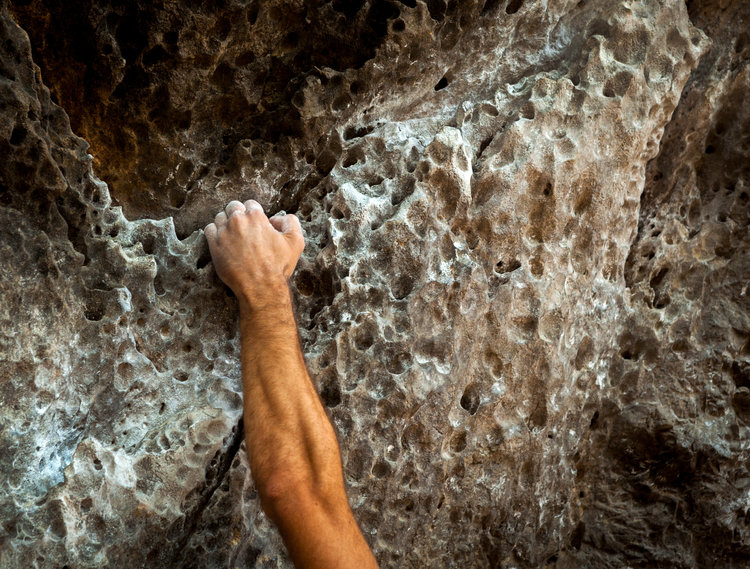
Kettle Bell swinging supercharges Grip/Forearm strength and endurance and increases tolerance to lactic acid building up in the Forearms. Thus delaying the onset of ‘screaming forearms’ (and fingers uncurling off the holds) during a sustained rock climb.
TOP TIPS
- Be patient, always start with a Kettle Bell (KB) weight that you can handle with excellent form.
- Note the breathing patterns: I Inhale as I ‘Hike Pass’ the KB through my legs as I initiate the ‘Hinge’ and I Exhale sharply at the top of the swing.
- Brace the abdominals at the top off the Swing to prevent the lower back becoming unstable and over-arching (Lordosis) and therefore help maintain a neutral Lower Back (Lumbar Spine).
- Do not practice KB swings when fatigued until the skill is nailed down. Little and often to begin with.
- Build up gradually, aim for a total of 50 swings over an extended period of weeks (if required) with the following sequence: 1 x set of 5 swings per arm, take a couple minutes of break between sets, then repeat: increase the sets weekly. Once 50 swings in total are achieved. Then progress to sets of 6,7,8,9,10 arm swings until you reach 100 swings in total. Add the extra swing on a weekly basis. Eventually you can build up to 20 swings per arm and reduce the recovery between sets. Practice 3 times a week.